
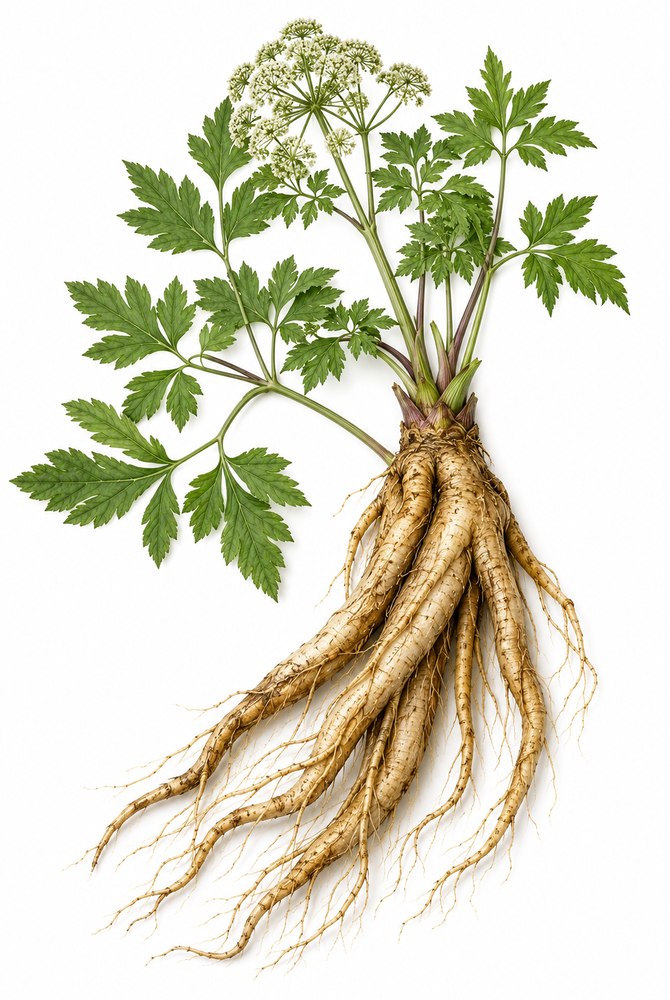
Korean Angelica Root
Overview
Danggwi is the foremost blood tonic of Korean tradition, central to formulas such as Samul-tang. Its name is often read as 'should return', evoking the restoration of what the body has lost. Korean Angelica gigas is botanically distinct from the Chinese Angelica sinensis, a point this platform documents carefully.
In the Donguibogam
寶鑑
Traditional uses recorded in the Donguibogam
- Tonifies and invigorates the blood
- Regulates menstruation
- Moistens the intestines
- Relieves pain from blood stasis
Traditional applications recorded in the classical text
- Blood-deficiency patterns (pallor, dizziness)
- Menstrual irregularity
- Constipation from dryness
- Post-illness weakness
Traditional preparation
A core ingredient of Samul-tang (Four-Substance Decoction).
This describes traditional preparation recorded in the classics, not a recommendation for use today. DonguiHub does not provide dosage guidance — consult a qualified professional before using any herb.
Herbs Recorded Together in the Text
This summarizes formulas and records of incompatibility and dietary avoidance in the Donguibogam. It is a record of the classical text — not a recommendation, prescription, or medical advice. Amounts in the text (don, bun, etc.) are historical records, not modern recommended doses.
Recorded together in a formulaRecorded as to be avoided
Principles recorded in the text
和血, 須用當歸
To harmonize the blood, dang-gui must be used.
諸經引導
當歸一物, 頭止血上行, 身養血中守, 梢破血下流
Even within a single dang-gui root, the head stops bleeding and rises, the body nourishes blood and stays within, and the tail breaks blood and flows downward.
用根梢法
Formulas in which it is recorded
Samul-tang (Four Ingredient Decoction)四物湯Prepared rehmannia熟地黃White peony白芍藥Cnidium (Cheongung)川芎Dang-gui當歸
通治血病. 熟地黃ㆍ白芍藥ㆍ川芎ㆍ當歸 各一錢二分半
Treats blood disorders in general. Prepared rehmannia, white peony, cnidium and dang-gui, 1 don 2.5 bun each.
Source: Naegyeong-pyeon 《局方》
春倍川芎, 夏倍芍藥, 秋倍地黃, 冬倍當歸
Double the cnidium in spring, the peony in summer, the rehmannia in autumn and the dang-gui in winter.
一方
Dang-gui Bohyeol-tang當歸補血湯Astragalus黃芪Dang-gui當歸
黃芪 五錢, 當歸 二錢
Astragalus 5 don, dang-gui 2 don.
Source: Japbyeong-pyeon 《東垣》
血虛發熱
Heat arising from blood deficiency.
經曰
Bojung-ikgi-tang補中益氣湯Astragalus黃芪Ginseng人蔘White atractylodes白朮Licorice甘草Dang-gui (body)當歸身Tangerine peel陳皮Cimicifuga升麻Bupleurum柴胡
治勞役太甚, 或飮食失節, 身熱而煩, 自汗倦怠. 黃芪 一錢半, 人參ㆍ白朮ㆍ甘草 各一錢, 當歸身ㆍ陳皮 各五分, 升麻ㆍ柴胡 各三分
Treats excessive labor or irregular eating with body heat, vexation, spontaneous sweating and fatigue. Astragalus 1.5 don; ginseng, white atractylodes and licorice 1 don each; dang-gui body and tangerine peel 5 bun each; cimicifuga and bupleurum 3 bun each.
Source: Japbyeong-pyeon 《東垣》
當歸以和血脉
Dang-gui is used to harmonize the blood vessels.
《東垣》
Palmul-tang (Eight Ingredient Decoction)八物湯Ginseng人蔘White atractylodes白朮Poria白茯苓Licorice甘草Prepared rehmannia熟地黃White peony白芍藥Cnidium (Cheongung)川芎Dang-gui當歸
治虛勞, 氣血兩虛, 能調和陰陽. 人參ㆍ白朮ㆍ白茯苓ㆍ甘草ㆍ熟地黃ㆍ白芍藥ㆍ川芎ㆍ當歸 各一錢二分
Treats deficiency-taxation with deficiency of both qi and blood, and harmonizes yin and yang. Ginseng, white atractylodes, white poria, licorice, prepared rehmannia, white peony, cnidium and dang-gui, 1 don 2 bun each.
Source: Japbyeong-pyeon 《易老》
Foods to avoid while taking it
Foods to avoid while taking (服藥食忌)Korean Angelica Root當歸Hot wheat flour (熱麪)熱麪
當歸, 惡熱麪
Dang-gui dislikes hot wheat flour (熱麪).
Source: Tangaek-pyeon · 服藥食忌
Cautions
Frequently asked questions
Is Korean danggwi the same as Chinese dang gui?
No. Korean danggwi is Angelica gigas, while Chinese dang gui is Angelica sinensis. They are related but distinct species with different chemical profiles.
Why is danggwi called a women's herb?
Its traditional prominence in blood-tonifying and menstruation-regulating formulas such as Samul-tang earned it that reputation, though classical use is not limited to women.
Sources
- 『동의보감』 탕액편, 허준, 1613 (원문) — 한문 원문
- 한의학고전DB (mediclassics.kr) — 원문 및 국역 자료 참조