
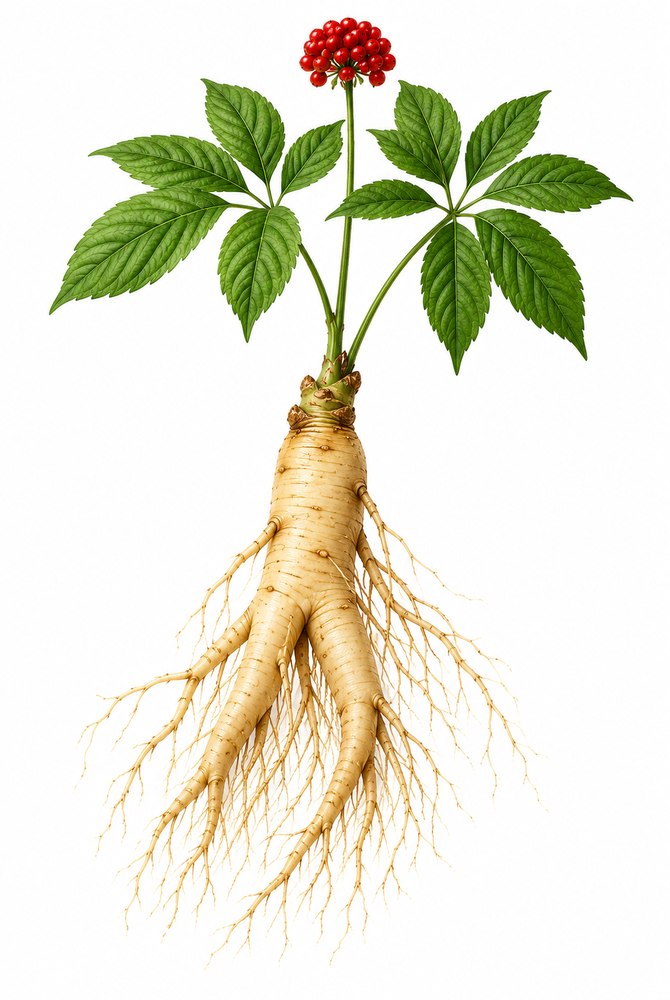
Ginseng
Overview
Ginseng is the most celebrated tonic herb in Korean traditional medicine, often called the king of herbs. In the Donguibogam it is described as a herb that strongly supplements vital energy (qi), calms the mind, and supports the five viscera. The text even preserves a classical identification verse for the wild root — "three branches, five leaves, back to the sun and facing the shade; if you wish to find me, look near the katsura tree" — and notes that a root shaped like a human figure was considered especially potent, giving rise to its old alternate name, 'spirit herb' (神草). The Donguibogam adds that it grows deep in shaded mountains near katsura and lacquer trees, with a stem resembling balloon flower, flowering in the third and fourth lunar months and fruiting after autumn. It has been cultivated in Korea for centuries and remains central to Korean herbal culture.
In the Donguibogam
寶鑑
Traditional uses recorded in the Donguibogam
- Greatly tonifies qi (vital energy)
- Strengthens the spleen and lung
- Generates body fluids
- Calms the mind and spirit
- Supports recovery after illness
Traditional applications recorded in the classical text
- Fatigue and low energy
- Loss of appetite
- Shortness of breath
- Poor concentration
- Recovery after illness
Traditional preparation
Commonly combined in formulas such as Sipjeondaebo-tang and Samul-tang derivatives. The classical text also notes the root head (蘆頭) must be removed before use, as leaving it in was said to induce vomiting, and that dried roots should be stored tightly sealed — ideally with asarum root — to prevent insect damage.
This describes traditional preparation recorded in the classics, not a recommendation for use today. DonguiHub does not provide dosage guidance — consult a qualified professional before using any herb.
Herbs Recorded Together in the Text
This summarizes formulas and records of incompatibility and dietary avoidance in the Donguibogam. It is a record of the classical text — not a recommendation, prescription, or medical advice. Amounts in the text (don, bun, etc.) are historical records, not modern recommended doses.
Recorded together in a formulaRecorded as to be avoided
Principles recorded in the text
補氣, 須用人參
To supplement qi, ginseng must be used.
諸經引導
Formulas in which it is recorded
Sagunja-tang (Four Gentlemen Decoction)四君子湯Ginseng人蔘Poria白茯苓White atractylodes白朮Licorice甘草
補眞氣虛弱, 治氣短, 氣少. 人參(去蘆)ㆍ白茯苓ㆍ白朮ㆍ甘草(灸) 各一錢二分半
Supplements true qi that is weak, and treats shortness and scarcity of qi. Ginseng (reed removed), white poria, white atractylodes and roasted licorice, each 1 don 2.5 bun.
Source: Naegyeong-pyeon 《局方》
人參, 補肺扶脾, 白朮, 健脾燥濕, 茯苓, 降氣滲濕, 甘草, 補胃和中
Ginseng supplements the lung and supports the spleen; white atractylodes strengthens the spleen and dries dampness; poria lowers qi and seeps dampness; licorice supplements the stomach and harmonizes the middle.
方氏曰
Yukgunja-tang (Six Gentlemen Decoction)六君子湯Banha半夏White atractylodes白朮Tangerine peel陳皮Poria白茯苓Ginseng人蔘Licorice甘草
治氣虛痰盛. 半夏ㆍ白朮 各一錢半, 陳皮ㆍ白茯苓ㆍ人參 各一錢, 甘草(灸) 五分
Treats qi deficiency with abundant phlegm. Banha and white atractylodes 1.5 don each; tangerine peel, white poria and ginseng 1 don each; roasted licorice 5 bun.
Source: Naegyeong-pyeon 《正傳》
Bojung-ikgi-tang補中益氣湯Astragalus黃芪Ginseng人蔘White atractylodes白朮Licorice甘草Dang-gui (body)當歸身Tangerine peel陳皮Cimicifuga升麻Bupleurum柴胡
治勞役太甚, 或飮食失節, 身熱而煩, 自汗倦怠. 黃芪 一錢半, 人參ㆍ白朮ㆍ甘草 各一錢, 當歸身ㆍ陳皮 各五分, 升麻ㆍ柴胡 各三分
Treats excessive labor or irregular eating with body heat, vexation, spontaneous sweating and fatigue. Astragalus 1.5 don; ginseng, white atractylodes and licorice 1 don each; dang-gui body and tangerine peel 5 bun each; cimicifuga and bupleurum 3 bun each.
Source: Japbyeong-pyeon 《東垣》
上喘氣短, 損其元氣, 用人參以補之
For panting and shortness of breath that damage original qi, ginseng is used to supplement it.
《東垣》
Palmul-tang (Eight Ingredient Decoction)八物湯Ginseng人蔘White atractylodes白朮Poria白茯苓Licorice甘草Prepared rehmannia熟地黃White peony白芍藥Cnidium (Cheongung)川芎Dang-gui當歸
治虛勞, 氣血兩虛, 能調和陰陽. 人參ㆍ白朮ㆍ白茯苓ㆍ甘草ㆍ熟地黃ㆍ白芍藥ㆍ川芎ㆍ當歸 各一錢二分
Treats deficiency-taxation with deficiency of both qi and blood, and harmonizes yin and yang. Ginseng, white atractylodes, white poria, licorice, prepared rehmannia, white peony, cnidium and dang-gui, 1 don 2 bun each.
Source: Japbyeong-pyeon 《易老》
Recorded as incompatible
Incompatible (相反)Ginseng人蔘Veratrum (Yeoro)藜蘆
人參, 丹參, 沙參, 苦參, 玄參, 紫參, 細辛, 芍藥, 皆與藜蘆相反
Ginseng, danshen, shashen, kushen, xuanshen, zishen, asarum and peony are all incompatible with veratrum.
Source: Tangaek-pyeon · 相反藥
Incompatible (相反)Ginseng人蔘Oryeongji (五靈脂)五靈脂
人參, 反五靈脂
Ginseng is incompatible with Oryeongji (五靈脂).
Source: Tangaek-pyeon · 相反藥
Cautions
Frequently asked questions
What is ginseng used for in Korean medicine?
In the Donguibogam tradition, ginseng is used as a tonic to restore vital energy, support digestion and breathing, and calm the mind, especially in states of fatigue and weakness.
Is Korean ginseng the same as American ginseng?
No. Korean ginseng (Panax ginseng) is traditionally classified as slightly warm, while American ginseng (Panax quinquefolius) is considered cooler in nature; they are used differently.
Is ginseng safe for everyone?
No. Traditional sources advise caution for heat-excess constitutions, high blood pressure, and acute fevers, and modern guidance notes possible drug interactions. Seek professional advice.
Why does the root head need to be removed before use?
The Donguibogam explicitly warns that the root head (蘆頭), the top portion where the stem meets the root, was believed to induce vomiting if left on, so classical preparation always removed it first.
Sources
- 『동의보감』 탕액편, 허준, 1613 (원문) — 한문 원문
- 한의학고전DB (mediclassics.kr) — 원문 및 국역 자료 참조