
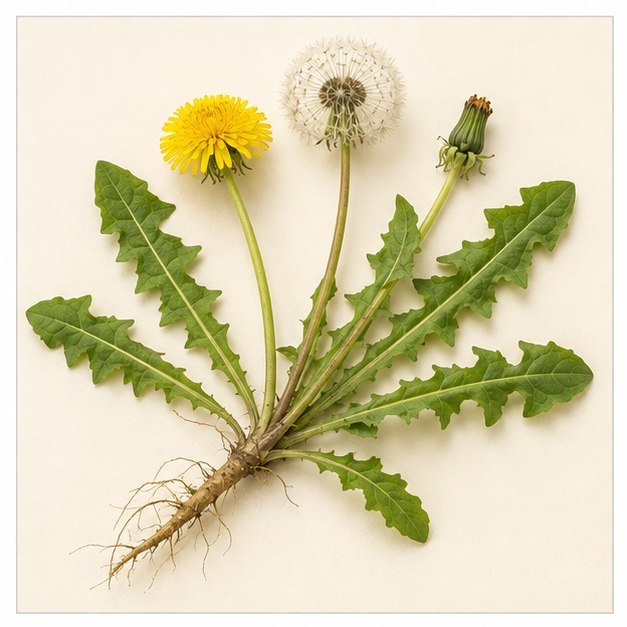
Dandelion
Overview
Dandelion is one of the most familiar roadside plants in Korea, its yellow flowers and milky sap known to almost every child. The Donguibogam records it under its old vernacular name (므은드레, the root of today's "mindeulle") as a remedy for breast abscess and swelling, noting that snapping its stem releases a white sap and that people commonly ate the plant.
In the Donguibogam
寶鑑
Traditional functions
- Clears heat, resolves toxin
- Disperses breast nodules and swelling
- Resolves boils and carbuncles
- Relieves food-toxin stagnation
Traditional applications
- Early-stage breast swelling or nodules
- Boils and carbuncles
- Food-related toxin or stagnation
- General heat-toxin skin eruptions
Traditional preparation
Decoction 8–20g of the fresh or dried whole plant; also eaten as a spring green.
Cautions
Frequently asked questions
Is the dandelion in the Donguibogam the same plant people eat as a spring green?
Yes. The text itself notes that people commonly ate the plant, and the same species is still gathered as a bitter spring green (mindeulle-namul) in Korea today.
What was dandelion traditionally used for?
The Donguibogam highlights breast abscess and swelling as its main use, alongside later commentary on resolving heat-toxin, dispersing nodules, and treating boils.
Sources
- 동의보감 탕액편 (원문) — 한문 원문 발췌 — 한의학고전DB 탕액편 대조 검증 완료 (DATA-001)
- 한의학고전DB (mediclassics.kr) — 국역 참조 후 자체 재서술 (LEGAL-001)