
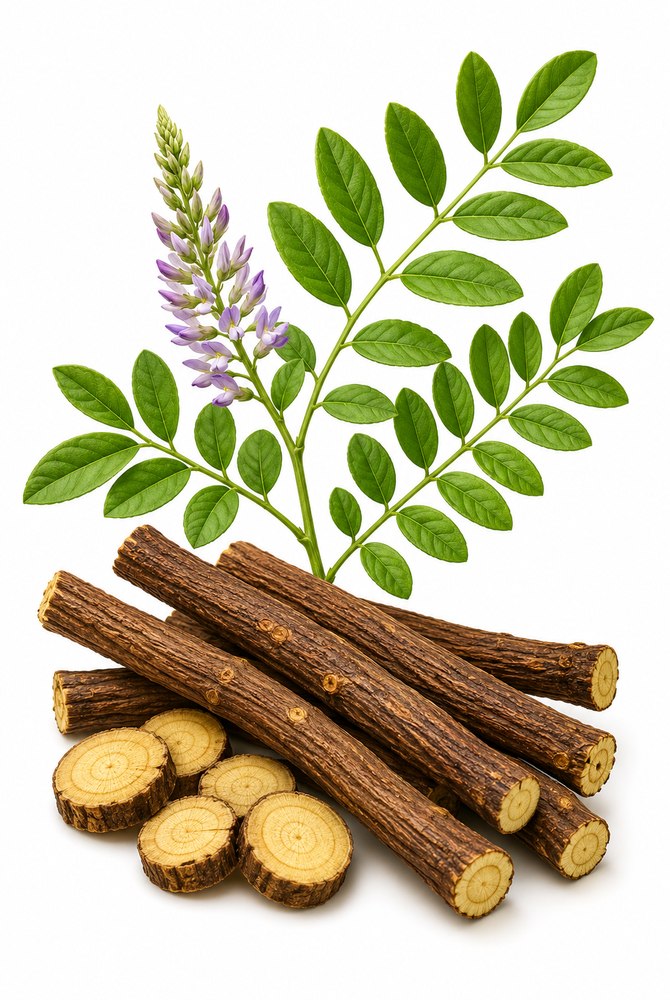
Licorice Root
Overview
Licorice root, the dried root and rhizome of a perennial legume, appears in more traditional Korean formulas than almost any other herb. Known as the harmonizer, it is used to moderate and unify the actions of other ingredients, ease the digestive system, and soothe coughs. The Donguibogam states this role in strikingly specific terms — that licorice alone can settle seventy-two kinds of mineral drugs and twelve hundred kinds of herbs into harmony, which is why the text honors it with the title 'elder statesman' (國老). The Korean saying 'like licorice in the medicine cabinet' describes something present everywhere. The text also records where the root's alternate name 'powder herb' (粉草) comes from — the root is judged good quality when it is firm and dense enough that snapping it releases a fine powder.
In the Donguibogam
寶鑑
Traditional uses recorded in the Donguibogam
- Harmonizes formulas
- Tonifies the spleen and qi
- Moistens the lung, relieves cough
- Relieves spasmodic pain
- Moderates herb toxicity
Traditional applications recorded in the classical text
- Digestive weakness
- Cough and sore throat
- Abdominal cramping
- Included in most classical formulas
Traditional preparation
Roasted (honey-fried) licorice is used for tonifying purposes, since roasting is said to harmonize the middle while the raw root instead purges heat. The Donguibogam separately records two sub-parts: the thin root tip (梢), used for painful, difficult urination, and the root nodes (節), used raw to reduce swelling and clear toxicity.
This describes traditional preparation recorded in the classics, not a recommendation for use today. DonguiHub does not provide dosage guidance — consult a qualified professional before using any herb.
Herbs Recorded Together in the Text
This summarizes formulas and records of incompatibility and dietary avoidance in the Donguibogam. It is a record of the classical text — not a recommendation, prescription, or medical advice. Amounts in the text (don, bun, etc.) are historical records, not modern recommended doses.
Recorded together in a formulaRecorded as to be avoided
Principles recorded in the text
凡純寒純熱藥中, 須用甘草以緩其力. 寒熱相雜者, 亦用之以和其性
Among purely cold or purely hot medicines, licorice is used to ease their force; where cold and heat are mixed, it is also used to harmonize their natures.
制藥方法 · 《入門》
Formulas in which it is recorded
Sagunja-tang (Four Gentlemen Decoction)四君子湯Ginseng人蔘Poria白茯苓White atractylodes白朮Licorice甘草
補眞氣虛弱, 治氣短, 氣少. 人參(去蘆)ㆍ白茯苓ㆍ白朮ㆍ甘草(灸) 各一錢二分半
Supplements true qi that is weak, and treats shortness and scarcity of qi. Ginseng (reed removed), white poria, white atractylodes and roasted licorice, each 1 don 2.5 bun.
Source: Naegyeong-pyeon 《局方》
人參, 補肺扶脾, 白朮, 健脾燥濕, 茯苓, 降氣滲濕, 甘草, 補胃和中
Ginseng supplements the lung and supports the spleen; white atractylodes strengthens the spleen and dries dampness; poria lowers qi and seeps dampness; licorice supplements the stomach and harmonizes the middle.
方氏曰
Yukgunja-tang (Six Gentlemen Decoction)六君子湯Banha半夏White atractylodes白朮Tangerine peel陳皮Poria白茯苓Ginseng人蔘Licorice甘草
治氣虛痰盛. 半夏ㆍ白朮 各一錢半, 陳皮ㆍ白茯苓ㆍ人參 各一錢, 甘草(灸) 五分
Treats qi deficiency with abundant phlegm. Banha and white atractylodes 1.5 don each; tangerine peel, white poria and ginseng 1 don each; roasted licorice 5 bun.
Source: Naegyeong-pyeon 《正傳》
Bojung-ikgi-tang補中益氣湯Astragalus黃芪Ginseng人蔘White atractylodes白朮Licorice甘草Dang-gui (body)當歸身Tangerine peel陳皮Cimicifuga升麻Bupleurum柴胡
治勞役太甚, 或飮食失節, 身熱而煩, 自汗倦怠. 黃芪 一錢半, 人參ㆍ白朮ㆍ甘草 各一錢, 當歸身ㆍ陳皮 各五分, 升麻ㆍ柴胡 各三分
Treats excessive labor or irregular eating with body heat, vexation, spontaneous sweating and fatigue. Astragalus 1.5 don; ginseng, white atractylodes and licorice 1 don each; dang-gui body and tangerine peel 5 bun each; cimicifuga and bupleurum 3 bun each.
Source: Japbyeong-pyeon 《東垣》
心火乘脾, 用灸甘草之甘溫, 以瀉火熱而補胃中元氣
When heart fire rides upon the spleen, the sweet warmth of roasted licorice is used to drain fire-heat and supplement original qi in the stomach.
《東垣》
Palmul-tang (Eight Ingredient Decoction)八物湯Ginseng人蔘White atractylodes白朮Poria白茯苓Licorice甘草Prepared rehmannia熟地黃White peony白芍藥Cnidium (Cheongung)川芎Dang-gui當歸
治虛勞, 氣血兩虛, 能調和陰陽. 人參ㆍ白朮ㆍ白茯苓ㆍ甘草ㆍ熟地黃ㆍ白芍藥ㆍ川芎ㆍ當歸 各一錢二分
Treats deficiency-taxation with deficiency of both qi and blood, and harmonizes yin and yang. Ginseng, white atractylodes, white poria, licorice, prepared rehmannia, white peony, cnidium and dang-gui, 1 don 2 bun each.
Source: Japbyeong-pyeon 《易老》
Recorded as incompatible
Incompatible (相反)Licorice Root甘草Euphorbia (Daegeuk)大戟Genkwa (Wonhwa)芫花Kansui (Gamsu)甘遂Sargassum (Haejo)海藻
大戟, 芫花, 甘遂, 海藻, 皆與甘草相反
Euphorbia, genkwa, kansui and sargassum are all incompatible with licorice.
Source: Tangaek-pyeon · 相反藥
Foods to avoid while taking it
Foods to avoid while taking (服藥食忌)Licorice Root甘草Songchae (cabbage-type)菘菜Sargassum (Haejo)海藻Pork猪肉
有甘草, 勿食菘菜, 海藻, 猪肉. 一云, 服甘草而食菘, 卽令病不除
When licorice is included, do not eat songchae (a cabbage-type vegetable), sargassum or pork. One source says that eating songchae while taking licorice keeps the illness from clearing.
Source: Tangaek-pyeon · 服藥食忌
Cautions
Frequently asked questions
Why is licorice in so many formulas?
Traditional sources describe licorice as harmonizing the hundred medicines: it moderates harsh ingredients, unifies a formula's action, and improves taste.
Is licorice root the same as licorice candy?
Not exactly. The herb is the dried root; much modern candy is flavored with anise instead of real licorice.
Does raw and roasted licorice work the same way?
No — the Donguibogam distinguishes them: roasted (honey-fried) licorice harmonizes and warms the middle, while the raw root instead purges heat, which is why prescriptions specify one or the other.
Sources
- 『동의보감』 탕액편, 허준, 1613 (원문) — 한문 원문
- 한의학고전DB (mediclassics.kr) — 원문 및 국역 자료 참조