
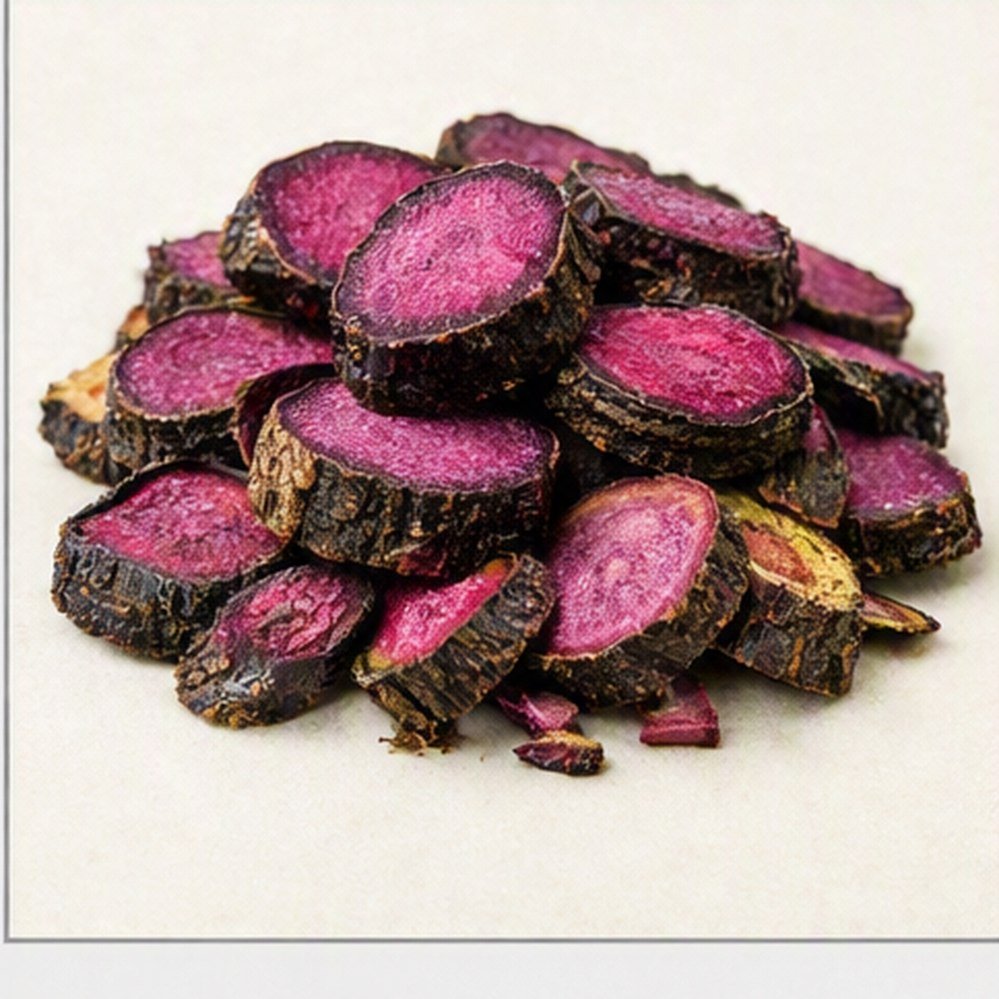
Gromwell Root
Gromwell Root (자초, 紫草) is recorded in the Donguibogam as a heat-clearing, blood-cooling, toxin-resolving herb. Its nature is cold (some sources: neutral) and its taste bitter (some sources: sweet), associated with the Heart, Liver meridians. Traditional uses recorded in the text include cools the blood, resolves toxin, promotes rash eruption. Caution: Cold in nature; not suited to loose stool or a cold, weak digestion.
Overview
Gromwell's Korean name, jichi, is still recognized today mainly through its use as a purple dye and as the base of a traditional skin ointment (jacho-gobyak). The Donguibogam records exactly this dual identity — noting it is the same root used to dye things purple, alongside its medicinal use for jaundice-type swelling and children's pox rash.
In the Donguibogam
寶鑑
Traditional uses recorded in the Donguibogam
- Cools the blood
- Resolves toxin
- Promotes rash eruption
- Unblocks urination
Traditional applications recorded in the classical text
- Jaundice-type swelling
- Abdominal bloating
- Sores and skin eruptions
- Slow-erupting childhood rash (classical use)
Traditional preparation
Also prepared as a topical oil or ointment.
This describes traditional preparation recorded in the classics, not a recommendation for use today. DonguiHub does not provide dosage guidance — consult a qualified professional before using any herb.
Cautions
Frequently asked questions
Is this the same root used for purple dye and jacho ointment?
Yes — the Donguibogam explicitly identifies it as the root used to dye things purple, alongside recording its medicinal uses for jaundice-type swelling and skin conditions.
What is gromwell's main traditional use?
Traditionally, treating jaundice and abdominal swelling, and helping childhood pox rash erupt fully; today it survives mainly in topical skin preparations.
Sources
- 『동의보감』 탕액편, 허준, 1613 (원문) — 한문 원문
- 한의학고전DB (mediclassics.kr) — 원문 및 국역 자료 참조