
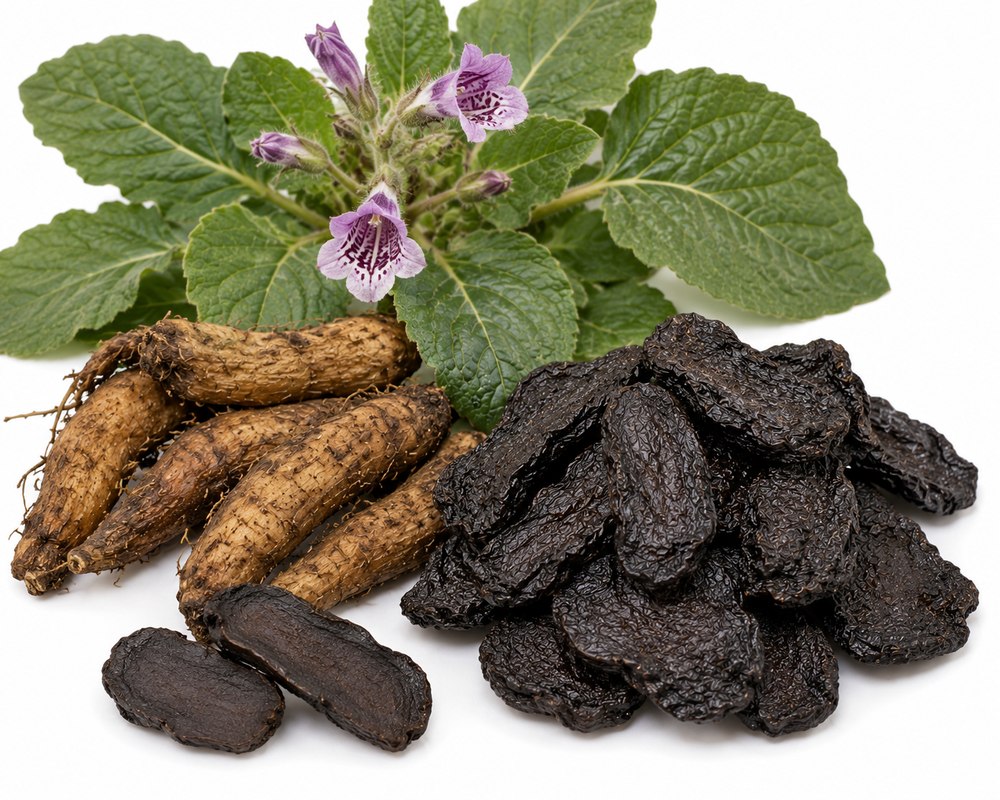
Prepared Rehmannia Root
Overview
Prepared rehmannia is the richest blood-nourishing root in Korean tradition, made by steaming and drying fresh rehmannia (saeng-jihwang) until it turns from pale to deep black and its nature shifts from cold to warm. The Donguibogam records both forms side by side, distinguishing the cooling, blood-clearing raw root from the warming, deeply tonifying prepared form.
In the Donguibogam
寶鑑
Traditional uses recorded in the Donguibogam
- Greatly tonifies the blood
- Nourishes liver and kidney yin
- Fills essence and marrow
- Strengthens sinews and bones
Traditional applications recorded in the classical text
- Blood-deficiency patterns (pallor, dizziness)
- Premature graying of hair
- Lower-back and knee weakness
- Post-illness or postpartum recovery
Traditional preparation
The core ingredient of Samul-tang and Yukmi-jihwang-hwan.
This describes traditional preparation recorded in the classics, not a recommendation for use today. DonguiHub does not provide dosage guidance — consult a qualified professional before using any herb.
Cautions
Frequently asked questions
What is the difference between raw and prepared rehmannia?
The Donguibogam distinguishes them clearly: raw rehmannia (saeng-jihwang) is cold in nature and clears heat from the blood, while prepared rehmannia (suk-jihwang), made by repeated steaming and drying, becomes warm and is used for deep, rich blood and essence tonification.
Why is it often combined with tangerine peel?
Prepared rehmannia's rich, dense quality can be heavy on digestion; tangerine peel's qi-regulating action is traditionally added to offset this and keep the stomach comfortable.
Sources
- 『동의보감』 탕액편, 허준, 1613 (원문) — 한문 원문
- 한의학고전DB (mediclassics.kr) — 원문 및 국역 자료 참조