
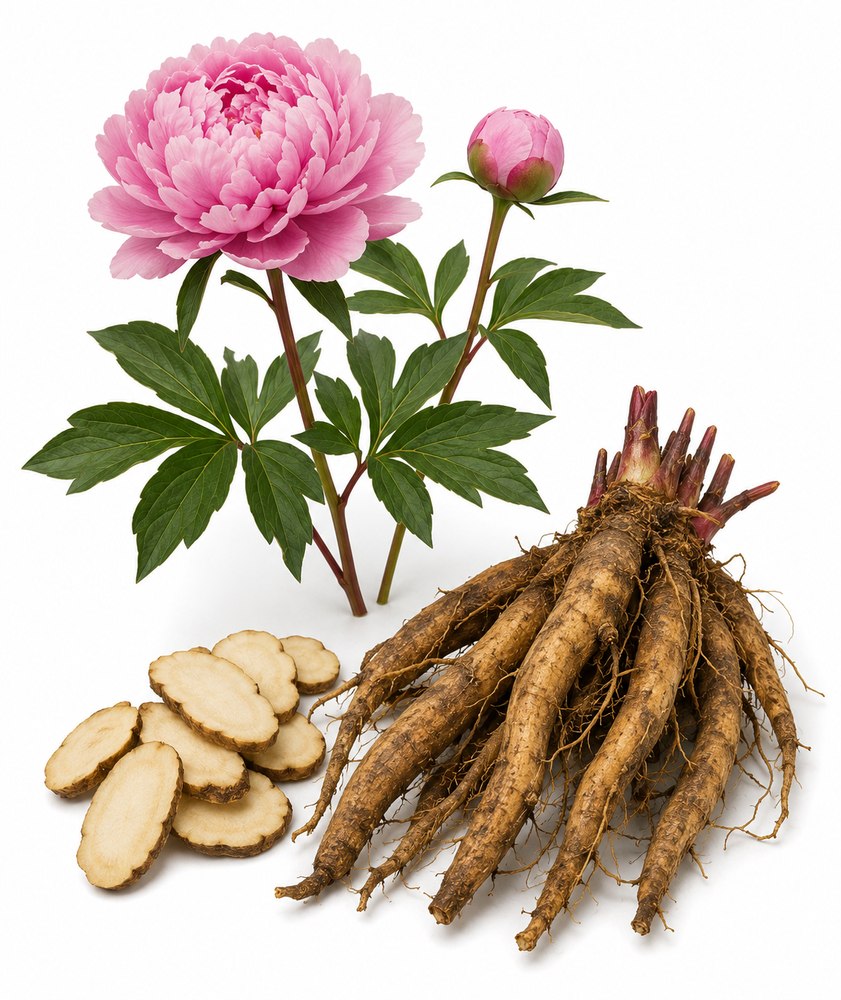
Peony Root
Overview
Peony root partners danggwi at the heart of Samul-tang, the foundational blood-nourishing formula. Tradition credits it with softening the liver and easing tension — the herb of choice for cramping pain, whether in the abdomen, the calves, or the monthly cycle. The white root (baekjagyak) is the standard nourishing form.
In the Donguibogam
寶鑑
Traditional uses recorded in the Donguibogam
- Nourishes the blood, restrains yin
- Softens the liver, relieves cramping pain
- Regulates menstruation
- Calms rising liver yang
Traditional applications recorded in the classical text
- Menstrual cramps and irregularity
- Muscle cramps and spasms
- Abdominal cramping pain
- Blood-deficiency patterns with pallor
Traditional preparation
Famously paired with licorice in Jakyakgamcho-tang for cramping pain.
This describes traditional preparation recorded in the classics, not a recommendation for use today. DonguiHub does not provide dosage guidance — consult a qualified professional before using any herb.
Herbs Recorded Together in the Text
This summarizes formulas and records of incompatibility and dietary avoidance in the Donguibogam. It is a record of the classical text — not a recommendation, prescription, or medical advice. Amounts in the text (don, bun, etc.) are historical records, not modern recommended doses.
Recorded together in a formulaRecorded as to be avoided
Formulas in which it is recorded
Samul-tang (Four Ingredient Decoction)四物湯Prepared rehmannia熟地黃White peony白芍藥Cnidium (Cheongung)川芎Dang-gui當歸
通治血病. 熟地黃ㆍ白芍藥ㆍ川芎ㆍ當歸 各一錢二分半
Treats blood disorders in general. Prepared rehmannia, white peony, cnidium and dang-gui, 1 don 2.5 bun each.
Source: Naegyeong-pyeon 《局方》
春倍川芎, 夏倍芍藥, 秋倍地黃, 冬倍當歸
Double the cnidium in spring, the peony in summer, the rehmannia in autumn and the dang-gui in winter.
一方
Palmul-tang (Eight Ingredient Decoction)八物湯Ginseng人蔘White atractylodes白朮Poria白茯苓Licorice甘草Prepared rehmannia熟地黃White peony白芍藥Cnidium (Cheongung)川芎Dang-gui當歸
治虛勞, 氣血兩虛, 能調和陰陽. 人參ㆍ白朮ㆍ白茯苓ㆍ甘草ㆍ熟地黃ㆍ白芍藥ㆍ川芎ㆍ當歸 各一錢二分
Treats deficiency-taxation with deficiency of both qi and blood, and harmonizes yin and yang. Ginseng, white atractylodes, white poria, licorice, prepared rehmannia, white peony, cnidium and dang-gui, 1 don 2 bun each.
Source: Japbyeong-pyeon 《易老》
Sogeonjung-tang小建中湯White peony白芍藥Cinnamon twig桂枝Licorice甘草
治虛勞, 裏急腹中痛, 夢寐失精, 四肢痠疼, 手足煩熱, 咽乾口燥. 白芍藥 五錢, 桂枝 三錢無則用薄桂, 甘草(灸) 一錢
Treats deficiency-taxation with inner tension and abdominal pain, loss of essence in dreams, aching limbs, vexing heat in the hands and feet, and a dry throat and mouth. White peony 5 don, cinnamon twig 3 don (use thin cinnamon bark if none), roasted licorice 1 don.
Source: Japbyeong-pyeon 《仲景》
芍藥味酸, 於土中瀉木爲君, 飴糖ㆍ甘草之溫, 補脾養胃爲臣
Peony, sour in taste, drains wood within the earth and serves as the monarch; the warmth of malt sugar and licorice supplements the spleen and nourishes the stomach as ministers.
《東垣》
Sipjeon-daebo-tang十全大補湯Ginseng人蔘White atractylodes白朮Poria白茯苓Licorice甘草Prepared rehmannia熟地黃White peony白芍藥Cnidium (Cheongung)川芎Dang-gui當歸Astragalus黃芪Cinnamon bark肉桂
治同上. 又治虛勞自汗. 人參ㆍ白朮ㆍ白茯苓ㆍ甘草ㆍ熟地黃ㆍ白芍藥ㆍ川芎ㆍ當歸ㆍ黃芪ㆍ肉桂 各一錢
Treats the same conditions as the preceding formula, and also spontaneous sweating from deficiency-taxation. Ginseng, white atractylodes, white poria, licorice, prepared rehmannia, white peony, cnidium, dang-gui, astragalus and cinnamon bark, 1 don each.
Source: Japbyeong-pyeon 《海藏》
黃芪建中湯ㆍ八物湯, 合爲一方. 治氣血俱衰, 陰陽幷弱, 法天地之成數也
It combines Hwanggi-geonjung-tang and Palmul-tang into one formula. It treats decline of both qi and blood and weakness of both yin and yang, modelled on the completing numbers of heaven and earth.
《海藏》
Recorded as incompatible
Incompatible (相反)Peony Root芍藥Veratrum (Yeoro)藜蘆
人參, 丹參, 沙參, 苦參, 玄參, 紫參, 細辛, 芍藥, 皆與藜蘆相反
Ginseng, danshen, shashen, kushen, xuanshen, zishen, asarum and peony are all incompatible with veratrum.
Source: Tangaek-pyeon · 相反藥
Cautions
Frequently asked questions
What is the difference between white and red peony root?
White peony (baekjagyak) is the cultivated, peeled, boiled root used to nourish blood and soften the liver; red peony (jeokjagyak) is typically the wild, unpeeled root used to cool blood and move stasis. Classical sources assign them different roles.
Why are peony and licorice combined for cramps?
Jakyakgamcho-tang, recorded since the Shanghan lun era, pairs peony's yin-nourishing, tension-easing quality with licorice's moderating sweetness — a two-herb formula long used for spasmodic pain.
Sources
- 『동의보감』 탕액편, 허준, 1613 (원문) — 한문 원문
- 한의학고전DB (mediclassics.kr) — 원문 및 국역 자료 참조