
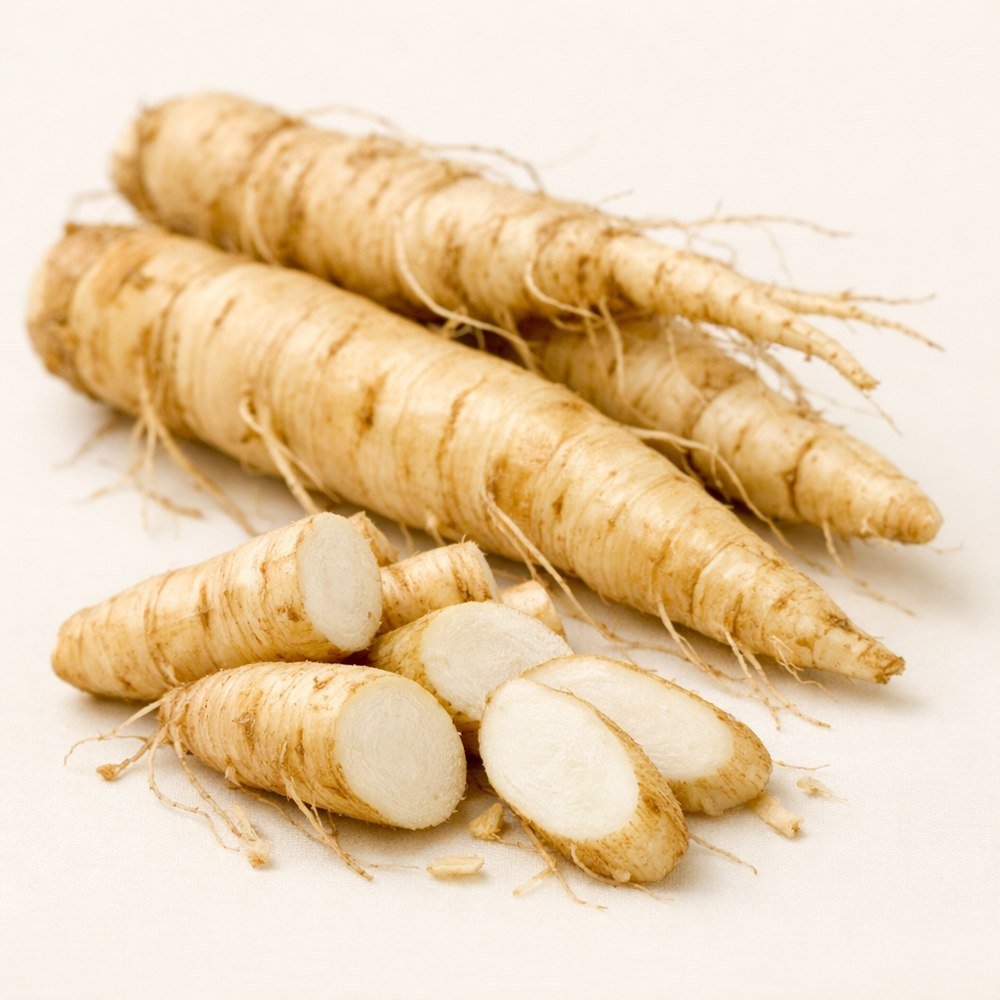
Adenophora Root
Overview
Deodeok is a mountain vegetable and a lung-nourishing herb in one — the balloon flower’s close cousin, familiar on Korean tables as a grilled, seasoned root. The Donguibogam records it as tonifying the center and boosting lung qi, and classical practice paired its cool, moistening nature against ginseng’s warmth.
In the Donguibogam
寶鑑
Traditional functions
- Nourishes lung yin, boosts lung qi
- Tonifies the center
- Expels pus, disperses swelling
- Moistens dryness
Traditional applications
- Dry cough from lung dryness
- Weak digestion with lung deficiency
- Sores and swellings
- Convalescence needing gentle nourishment
Traditional preparation
Decoction 8–16g; also eaten as a seasoned or grilled vegetable.
Cautions
Frequently asked questions
Is deodeok related to balloon flower (doraji)?
Yes — both belong to the bellflower family and are eaten as mountain-vegetable roots in Korea, but they are distinct species with different traditional actions: deodeok is more yin-nourishing and moistening, doraji more phlegm-resolving.
Is deodeok the same as the Chinese herb sha-shen?
The Donguibogam uses the name 沙參 (sha-shen); in Korean practice this is identified with deodeok (Adenophora), a moistening lung tonic distinct from ginseng despite the shared "-sam" naming.
Sources
- 동의보감 탕액편 (원문) — 한문 원문 발췌 — 한의학고전DB 탕액편 대조 검증 완료 (DATA-001)
- 한의학고전DB (mediclassics.kr) — 국역 참조 후 자체 재서술 (LEGAL-001)