
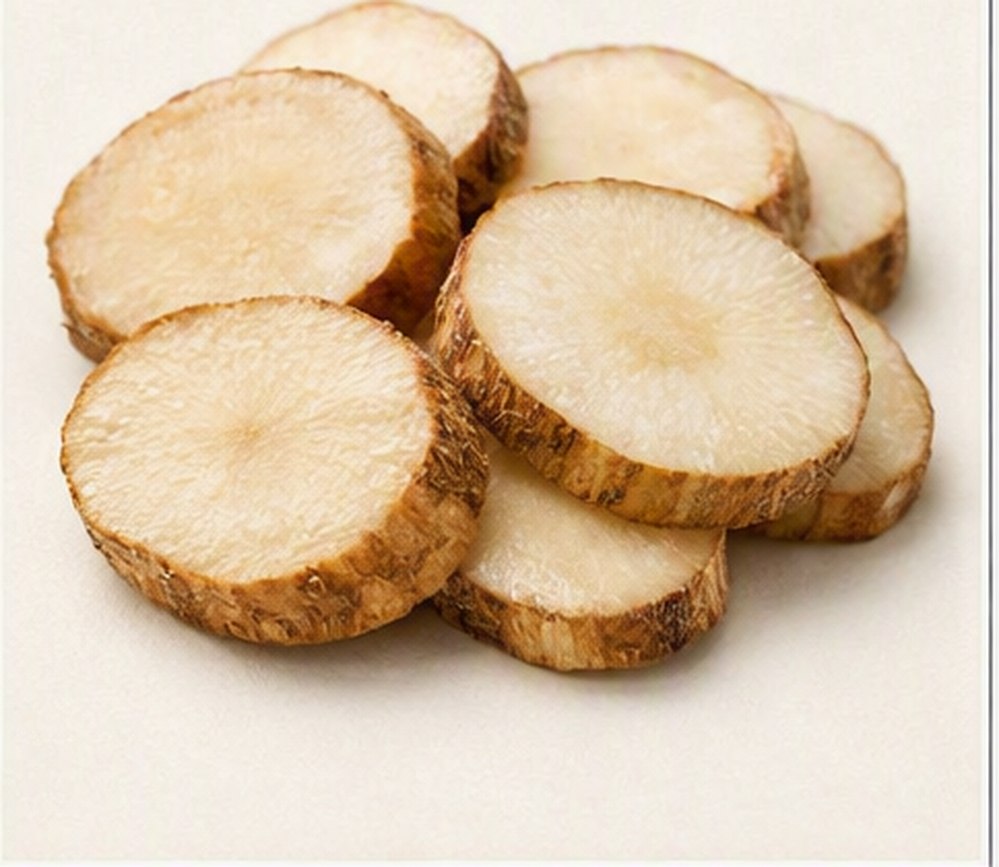
Alisma Rhizome
Overview
Alisma rhizome is the classic water-draining herb of Korean tradition, valued for clearing heat trapped in the bladder and freeing up water passages that have stalled. It is the sixth and final member of Yukmi-jihwang-hwan, added specifically to keep the formula's rich tonifying herbs from becoming stagnant.
In the Donguibogam
寶鑑
Traditional functions
- Drains dampness, promotes urination
- Clears bladder heat
- Frees the water passages
- Balances rich tonifying formulas
Traditional applications
- Edema and water retention
- Difficult or dribbling urination
- Cloudy or scanty urine
- Dizziness from fluid imbalance
Traditional preparation
Decoction 6–12g; a core ingredient of Yukmi-jihwang-hwan alongside rehmannia, cornus fruit, and yam.
Cautions
Frequently asked questions
Why is alisma added to Yukmi-jihwang-hwan when the formula is meant to tonify?
The Donguibogam tradition pairs rich tonifying herbs with a small counterbalance so they do not stagnate — alisma's draining action keeps rehmannia and cornus fruit's dense nourishment moving rather than accumulating.
Is alisma safe to take long-term on its own?
The Donguibogam explicitly cautions against excessive or prolonged use, noting it can drain kidney qi. It is traditionally used within formulas rather than as a standalone long-term herb.
Sources
- 동의보감 탕액편 (원문) — 한문 원문 발췌 — 한의학고전DB 탕액편 대조 검증 완료 (DATA-001)
- 한의학고전DB (mediclassics.kr) — 국역 참조 후 자체 재서술 (LEGAL-001)