
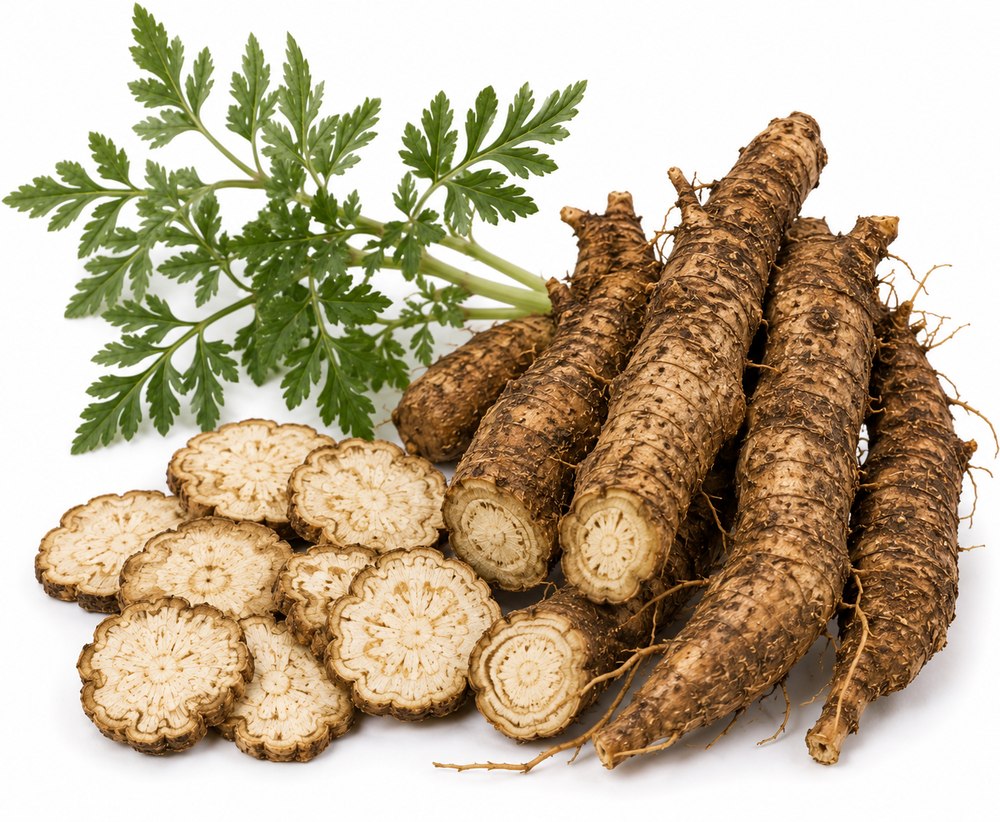
Cnidium Rhizome
Overview
Cnidium rhizome is celebrated in Korean tradition as the premier herb for blood-related headache, prized enough that the finest grade — shaped like a small bird's brain — was given the special name 'sparrow-brain cheongung.' It is a core ingredient of Samul-tang alongside danggwi, peony, and rehmannia.
In the Donguibogam
寶鑑
Traditional uses recorded in the Donguibogam
- Invigorates blood, dispels stasis
- Moves qi, relieves pain
- Dispels wind, stops headache
- Nourishes new blood
Traditional applications recorded in the classical text
- Headache from blood stasis or blood deficiency
- Menstrual irregularity and cramping
- Dizziness
- Pain from blood stagnation
Traditional preparation
A core ingredient of Samul-tang (Four-Substance Decoction) alongside danggwi, peony, and rehmannia.
This describes traditional preparation recorded in the classics, not a recommendation for use today. DonguiHub does not provide dosage guidance — consult a qualified professional before using any herb.
Herbs Recorded Together in the Text
This summarizes formulas and records of incompatibility and dietary avoidance in the Donguibogam. It is a record of the classical text — not a recommendation, prescription, or medical advice. Amounts in the text (don, bun, etc.) are historical records, not modern recommended doses.
Recorded together in a formulaRecorded as to be avoided
Formulas in which it is recorded
Samul-tang (Four Ingredient Decoction)四物湯Prepared rehmannia熟地黃White peony白芍藥Cnidium (Cheongung)川芎Dang-gui當歸
通治血病. 熟地黃ㆍ白芍藥ㆍ川芎ㆍ當歸 各一錢二分半
Treats blood disorders in general. Prepared rehmannia, white peony, cnidium and dang-gui, 1 don 2.5 bun each.
Source: Naegyeong-pyeon 《局方》
春倍川芎, 夏倍芍藥, 秋倍地黃, 冬倍當歸
Double the cnidium in spring, the peony in summer, the rehmannia in autumn and the dang-gui in winter.
一方
Palmul-tang (Eight Ingredient Decoction)八物湯Ginseng人蔘White atractylodes白朮Poria白茯苓Licorice甘草Prepared rehmannia熟地黃White peony白芍藥Cnidium (Cheongung)川芎Dang-gui當歸
治虛勞, 氣血兩虛, 能調和陰陽. 人參ㆍ白朮ㆍ白茯苓ㆍ甘草ㆍ熟地黃ㆍ白芍藥ㆍ川芎ㆍ當歸 各一錢二分
Treats deficiency-taxation with deficiency of both qi and blood, and harmonizes yin and yang. Ginseng, white atractylodes, white poria, licorice, prepared rehmannia, white peony, cnidium and dang-gui, 1 don 2 bun each.
Source: Japbyeong-pyeon 《易老》
Sipjeon-daebo-tang十全大補湯Ginseng人蔘White atractylodes白朮Poria白茯苓Licorice甘草Prepared rehmannia熟地黃White peony白芍藥Cnidium (Cheongung)川芎Dang-gui當歸Astragalus黃芪Cinnamon bark肉桂
治同上. 又治虛勞自汗. 人參ㆍ白朮ㆍ白茯苓ㆍ甘草ㆍ熟地黃ㆍ白芍藥ㆍ川芎ㆍ當歸ㆍ黃芪ㆍ肉桂 各一錢
Treats the same conditions as the preceding formula, and also spontaneous sweating from deficiency-taxation. Ginseng, white atractylodes, white poria, licorice, prepared rehmannia, white peony, cnidium, dang-gui, astragalus and cinnamon bark, 1 don each.
Source: Japbyeong-pyeon 《海藏》
黃芪建中湯ㆍ八物湯, 合爲一方. 治氣血俱衰, 陰陽幷弱, 法天地之成數也
It combines Hwanggi-geonjung-tang and Palmul-tang into one formula. It treats decline of both qi and blood and weakness of both yin and yang, modelled on the completing numbers of heaven and earth.
《海藏》
Cautions
Frequently asked questions
Can Cheongung be taken long-term on its own?
The Donguibogam explicitly warns against it: taken alone for a long period, it may 'dissipate genuine qi' — it is traditionally used within formulas alongside other herbs rather than as a standalone long-term tonic.
Why is it paired with danggwi, peony, and rehmannia?
This combination, Samul-tang, is the foundational blood-nourishing formula in Korean herbal tradition — cheongung's blood-moving action balances the more purely nourishing roles of the other three herbs.
Sources
- 『동의보감』 탕액편, 허준, 1613 (원문) — 한문 원문
- 한의학고전DB (mediclassics.kr) — 원문 및 국역 자료 참조