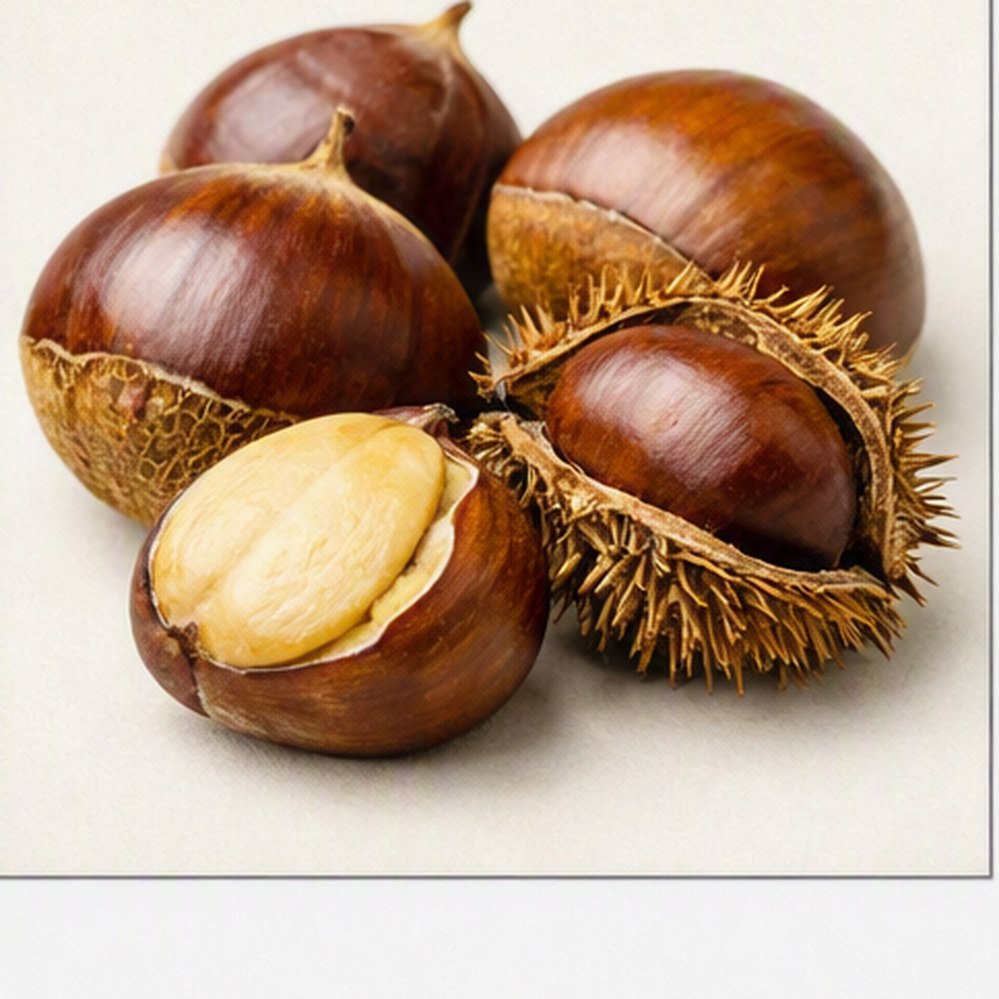
Chestnut
밤 (栗子) · Castanea crenata Siebold & Zucc.
Qi and kidney tonifying herb
Warm
Salty
Spleen, Stomach, Kidney
NatureWarm
TasteSalty
MeridiansSpleen, Stomach, Kidney
Part usedNut
FamilyFagaceae
CategoryQi and kidney tonifying herb
Overview
The chestnut is a food the Donguibogam treats as quietly medicinal: recorded as boosting qi, thickening the stomach and intestines, and tonifying the kidney. A staple of Korean autumn and ancestral rites, it was valued as a strengthening food that "lets a person endure hunger."
In the Donguibogam
東醫
寶鑑
寶鑑
性溫, 味醎, 無毒. 益氣, 厚腸胃, 補腎氣, 令人耐飢.
Source: Donguibogam, Tangaek-pyeon (Herbology volume)
TranslationIts nature is warm, its taste salty, and it is non-toxic. It boosts qi, thickens the stomach and intestines, tonifies kidney qi, and enables a person to endure hunger.
Traditional functions
- Boosts qi and strengthens digestion
- Tonifies kidney qi
- Strengthens the lower back and legs
- Sustaining, nourishing food
Traditional applications
- Weak digestion with loose stools
- Kidney-deficiency weakness of the low back and legs
- General fatigue
- Convalescent nourishment
Traditional preparation
Eaten roasted, steamed, or boiled; also dried for storage.
Cautions
Caution: Traditionally noted as hard to digest if eaten raw in quantity; roasting or steaming is preferred. May cause bloating in weak digestion. Consult a professional.
Advertisement
Frequently asked questions
How does the Donguibogam view the chestnut medicinally?
As a strengthening food — boosting qi, thickening the digestive tract, and tonifying kidney qi. It sits in the fruit section of the herbology volume as a nourishing, sustaining staple.
Why were chestnuts eaten roasted?
Classical sources note raw chestnuts are hard to digest; roasting or steaming was preferred to make them gentler on the stomach.
Sources
- 동의보감 탕액편 (원문) — 한문 원문 발췌 — 한의학고전DB 탕액편 대조 검증 완료 (DATA-001)
- 한의학고전DB (mediclassics.kr) — 국역 참조 후 자체 재서술 (LEGAL-001)
DonguiHub is an educational and informational platform about the history and tradition of Korean medicine. It does not provide medical advice, diagnosis, or treatment. Always consult a qualified healthcare professional about health conditions and before using any herb.