
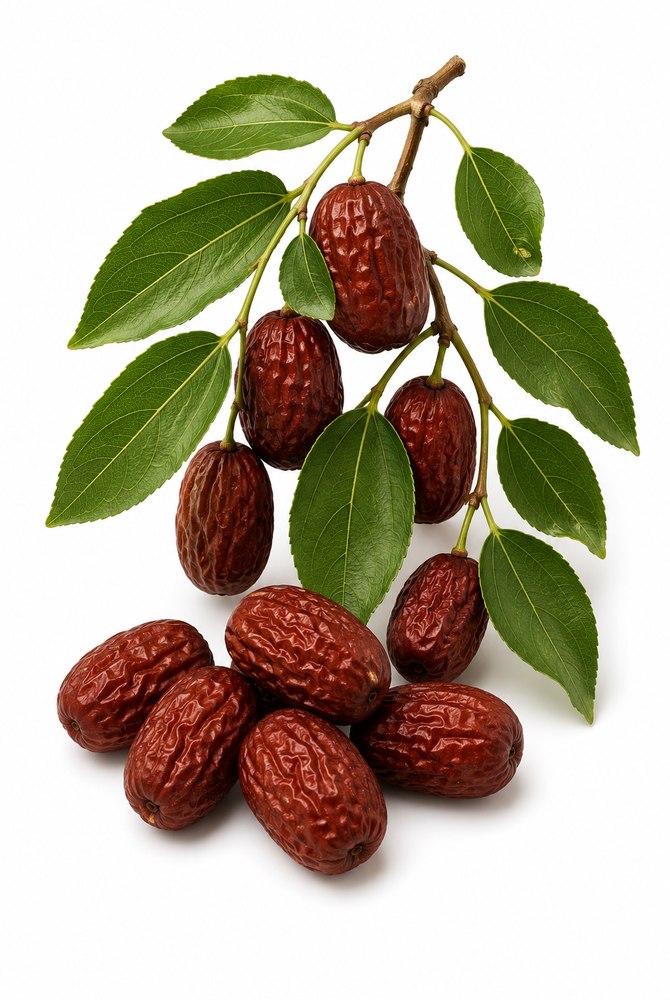
Jujube
Overview
Jujube, the fruit of a deciduous tree in the buckthorn family, is the Korean red date and among the most familiar herbs in daily Korean life — steeped into teas, cooked into samgyetang, and offered in ancestral rites. Its old alternate name, 'dried date' (乾棗), reflects how it was traditionally harvested in the eighth lunar month and sun-dried before use. The Donguibogam draws a sharp line between the raw and the prepared fruit: eaten raw in quantity, jujube was said to bloat the belly, waste the body, and stir cold-heat imbalance, whereas steamed and cooked, it instead nourishes the intestines and stomach, builds flesh, and boosts qi — the same fruit becoming a food-medicine only after processing. Its skin and flesh were also said to supplement deficiency, which is why classical formulas call for splitting each jujube open before adding it to a decoction. In traditional usage it nourishes the digestive center, calms the spirit, and softens the harshness of stronger herbs, which is why so many classical formulas end with a few jujubes.
In the Donguibogam
寶鑑
Traditional uses recorded in the Donguibogam
- Tonifies the spleen and stomach
- Nourishes the blood, calms the spirit
- Moderates and harmonizes other herbs
- Supports the twelve meridians
Traditional applications recorded in the classical text
- Poor appetite and weak digestion
- Restlessness and poor sleep
- Fatigue in delicate constitutions
- Added to formulas to soften harsh herbs
Traditional preparation
Always split open before adding, as the classics note the flesh beneath the skin is where the tonifying property lies; commonly paired with fresh ginger in classical formulas and boiled into daily teas.
This describes traditional preparation recorded in the classics, not a recommendation for use today. DonguiHub does not provide dosage guidance — consult a qualified professional before using any herb.
Cautions
Frequently asked questions
Why are jujube and ginger so often paired in formulas?
Classical practice pairs them to harmonize the defensive and nutritive aspects of the body — ginger warms and disperses while jujube nourishes and moderates, balancing each other and easing the formula on the stomach.
Is Korean daechu the same as the dates in Middle Eastern cuisine?
No. Jujube (Ziziphus jujuba) is botanically unrelated to the date palm. They look similar when dried but are different fruits with different traditional uses.
Is raw jujube the same medicinally as cooked jujube?
No — the Donguibogam draws a clear distinction. Eaten raw in quantity, it was said to bloat the belly and stir cold-heat imbalance, while steamed and cooked it nourishes the intestines, builds flesh, and boosts qi.
Sources
- 『동의보감』 탕액편, 허준, 1613 (원문) — 한문 원문
- 한의학고전DB (mediclassics.kr) — 원문 및 국역 자료 참조