
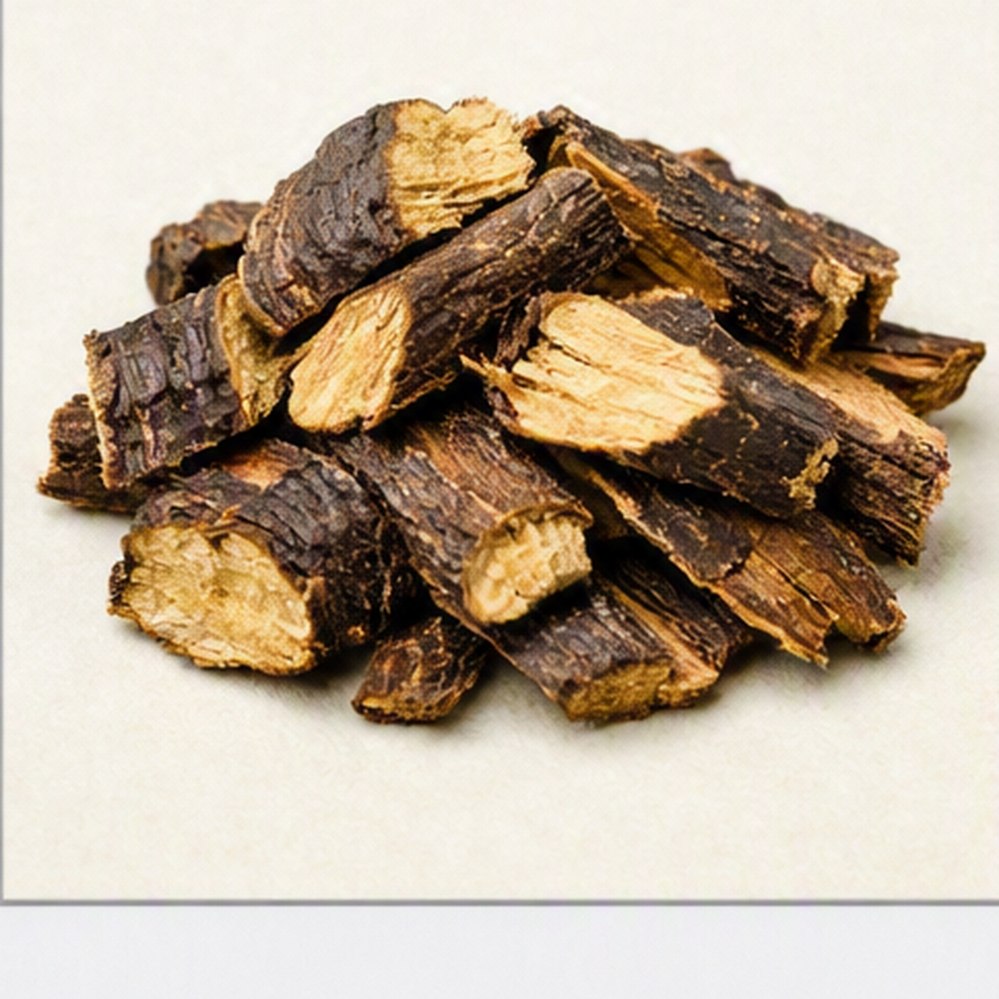
Eleuthero Bark
Overview
Eleuthero bark — from a thorny relative of ginseng — is the Donguibogam’s herb for strengthening sinew and bone against wind-damp. Recorded as treating the "five taxations and seven damages," it was prized for firming weak legs, easing joint pain, and building resilience, and remains a well-known Korean tonic bark today. The classical entry (五加皮) does not textually distinguish species — both common eleuthero (Eleutherococcus sessiliflorus) and its more thorn-covered relative, marketed today as "gasi-ogapi" (Eleutherococcus senticosus, the species usually meant by "Siberian ginseng" in Western herbal commerce), trace back to this same classical entry.
In the Donguibogam
寶鑑
Traditional functions
- Dispels wind-damp
- Strengthens sinews and bones
- Tonifies liver and kidney
- Firms weak legs and lower back
Traditional applications
- Joint pain from wind-damp
- Weak, aching legs and lower back
- Slow development in children (classical use)
- General fatigue with weakness
Traditional preparation
Decoction 6–12g; also steeped as a medicinal liquor (ogapi-ju).
Cautions
Frequently asked questions
Is eleuthero related to ginseng?
Yes — both are in the Araliaceae family. Eleuthero (once called "Siberian ginseng") is a thorny shrub whose bark is used to strengthen sinew and bone, distinct from true Panax ginseng but sharing a tonic reputation.
Is "gasi-ogapi" (thorny eleuthero) a different herb from ogapi?
Botanically, gasi-ogapi (Eleutherococcus senticosus — the species usually meant by "Siberian ginseng" in Western commerce) is a distinct but closely related species from common ogapi (Eleutherococcus sessiliflorus). The Donguibogam's single 五加皮 entry, however, does not separate them by species — both trace to this same classical text and share its recorded properties.
What does "five taxations and seven damages" mean?
It is a classical umbrella term for the many forms of chronic depletion and overwork; the Donguibogam records eleuthero bark as tonifying this broad pattern of deep weakness.
Sources
- 동의보감 탕액편 (원문) — 한문 원문 발췌 — 한의학고전DB 탕액편 대조 검증 완료 (DATA-001)
- 한의학고전DB (mediclassics.kr) — 국역 참조 후 자체 재서술 (LEGAL-001)