
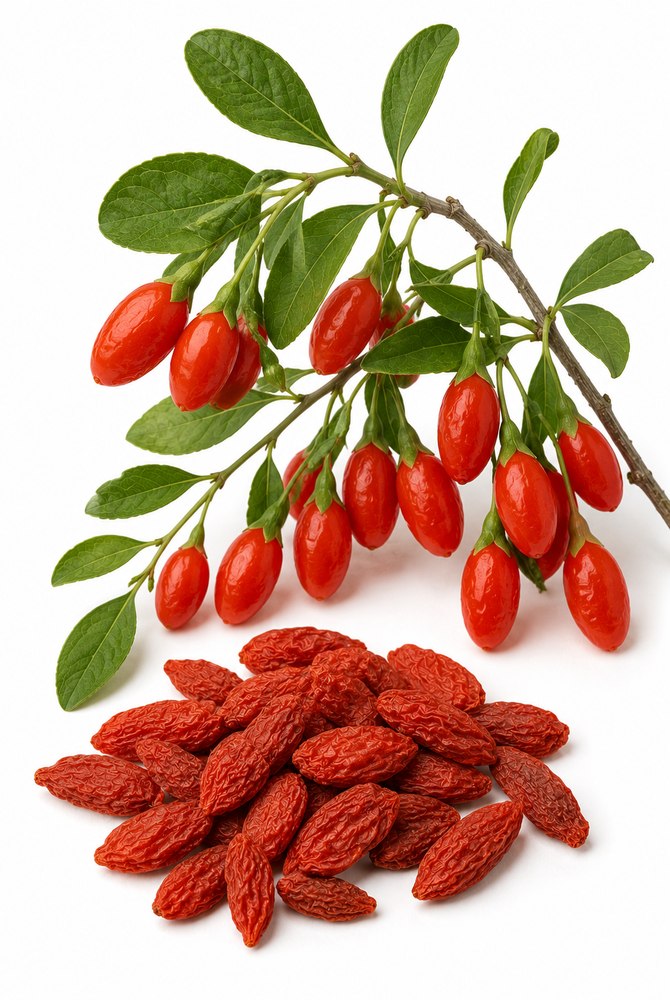
Goji Berry
Overview
Goji berry, the fruit of a deciduous shrub in the nightshade family, is the classic tonic for the liver and kidney in East Asian tradition, long associated with nourishing the essence, brightening the eyes, and graceful aging — so closely tied to longevity that the Donguibogam records its old alternate names 'earthly immortal' (地仙) and 'immortal's cane' (仙人杖). The classical text describes a single plant yielding three distinct medicines, each with its own potency: the red ripe berry (goji-ja) is only mildly cold, the stem bark (also called goji) is cold, and the root bark — known separately as 'earth bone' (地骨皮, jigolpi) — is the coldest and strongest of the three, traditionally used for the steaming, night-sweating heat of chronic depletion. The classics also record that the young leaves were traditionally gathered in spring and summer and simmered into soup, harvested alongside the autumn stems and fruit. In Korea, Cheongyang county is famous for its gugija, brewed as a daily tea.
In the Donguibogam
寶鑑
Traditional uses recorded in the Donguibogam
- Nourishes liver and kidney yin
- Replenishes essence, brightens the eyes
- Moistens the lung
- Supports strength of sinews and bones
Traditional applications recorded in the classical text
- Blurry vision and tired eyes
- Dizziness and lower-back weakness
- Chronic fatigue from overwork
- Dry cough in depleted constitutions
Traditional preparation
Widely drunk as tea, soaked in wine, or eaten as dried fruit.
This describes traditional preparation recorded in the classics, not a recommendation for use today. DonguiHub does not provide dosage guidance — consult a qualified professional before using any herb.
Cautions
Frequently asked questions
Are Korean gugija and Chinese goji the same plant?
They are close relatives used interchangeably in tradition: Korean gugija is typically Lycium chinense, while much Chinese goji is Lycium barbarum. Both appear in classical materia medica.
Why is goji associated with eyesight?
Classical theory holds that the liver opens into the eyes, so an herb that nourishes liver yin and essence was naturally credited with brightening vision — a use recorded across centuries of materia medica.
Is goji root bark the same medicine as the berry?
No — the Donguibogam treats them as related but distinct. The berry (goji-ja) is only mildly cold, while the root bark, called 'earth bone' (地骨皮), is the coldest and strongest of the plant's three parts and was used specifically for night sweats and steaming heat from chronic depletion.
Sources
- 『동의보감』 탕액편, 허준, 1613 (원문) — 한문 원문
- 한의학고전DB (mediclassics.kr) — 원문 및 국역 자료 참조