
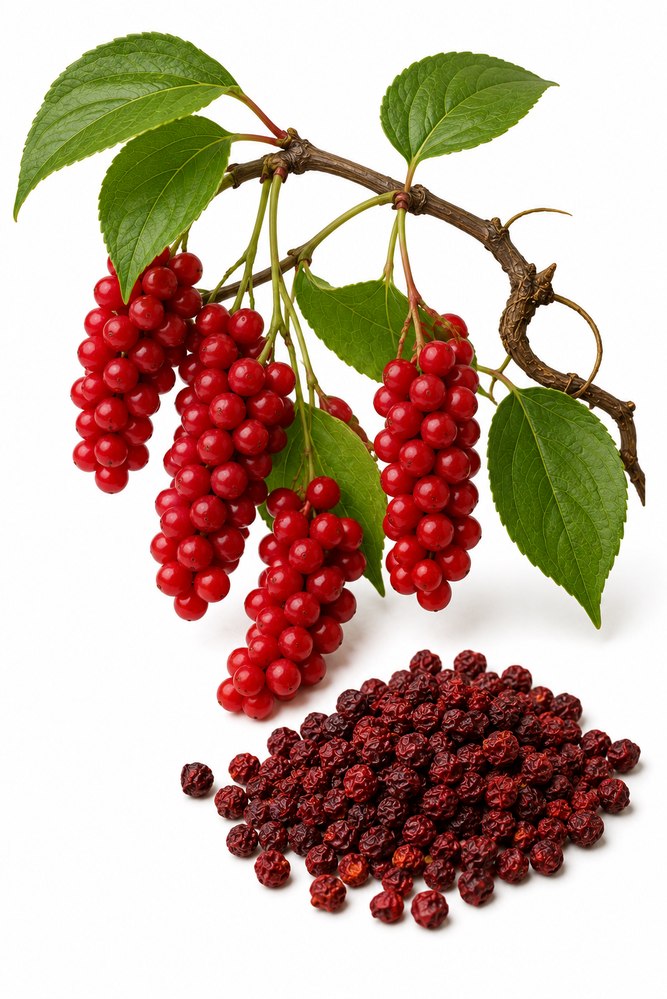
Schisandra Berry
Overview
Schisandra, the fruit of a deciduous woody vine, grows wild in deep mountains with red climbing stems, leaves like an apricot tree, and pale yellow-white flowers; its pea-sized berries turn a deep reddish-purple when ripe. It is named 'five-flavor berry' because the Donguibogam explains that the skin and flesh are sweet and sour, the seed within is pungent and bitter, and all parts carry a salty note besides — the full five flavors in one fruit. The text also preserves a specific endorsement from the celebrated physician Sun Simiao: that taking schisandra regularly through the summer months tonifies the qi of all five viscera. It is the classic herb for gathering what leaks — quieting chronic cough, sealing untimely sweat, and generating fluids for thirst. Korean omija-cha, steeped cold to a rose color, is beloved in summer.
In the Donguibogam
寶鑑
Traditional uses recorded in the Donguibogam
- Astringes the lung, stops chronic cough
- Restrains sweating, secures essence
- Generates fluids, relieves thirst
- Calms the heart, aids sleep
Traditional applications recorded in the classical text
- Lingering cough and shortness of breath
- Night sweats and spontaneous sweating
- Thirst and dry mouth
- Restless sleep with vivid dreaming
Traditional preparation
For tea, steep in cold water overnight to draw the sour-sweet flavor without bitterness.
This describes traditional preparation recorded in the classics, not a recommendation for use today. DonguiHub does not provide dosage guidance — consult a qualified professional before using any herb.
Cautions
Frequently asked questions
Does schisandra really taste of five flavors?
The dominant taste is sour, but classical texts describe the skin, flesh, seed, and core as each carrying different flavors — the origin of the name 'omija', the five-flavor fruit.
Why is omija tea brewed with cold water?
Cold steeping extracts the fruit's sourness and color while leaving behind bitter and astringent notes that hot water draws out — a technique long used in Korean households.
Is there a classical recommendation for taking schisandra in summer specifically?
Yes — the Donguibogam records a specific endorsement attributed to the physician Sun Simiao: that taking schisandra regularly through the summer months tonifies the qi of all five viscera.
Sources
- 『동의보감』 탕액편, 허준, 1613 (원문) — 한문 원문
- 한의학고전DB (mediclassics.kr) — 원문 및 국역 자료 참조