
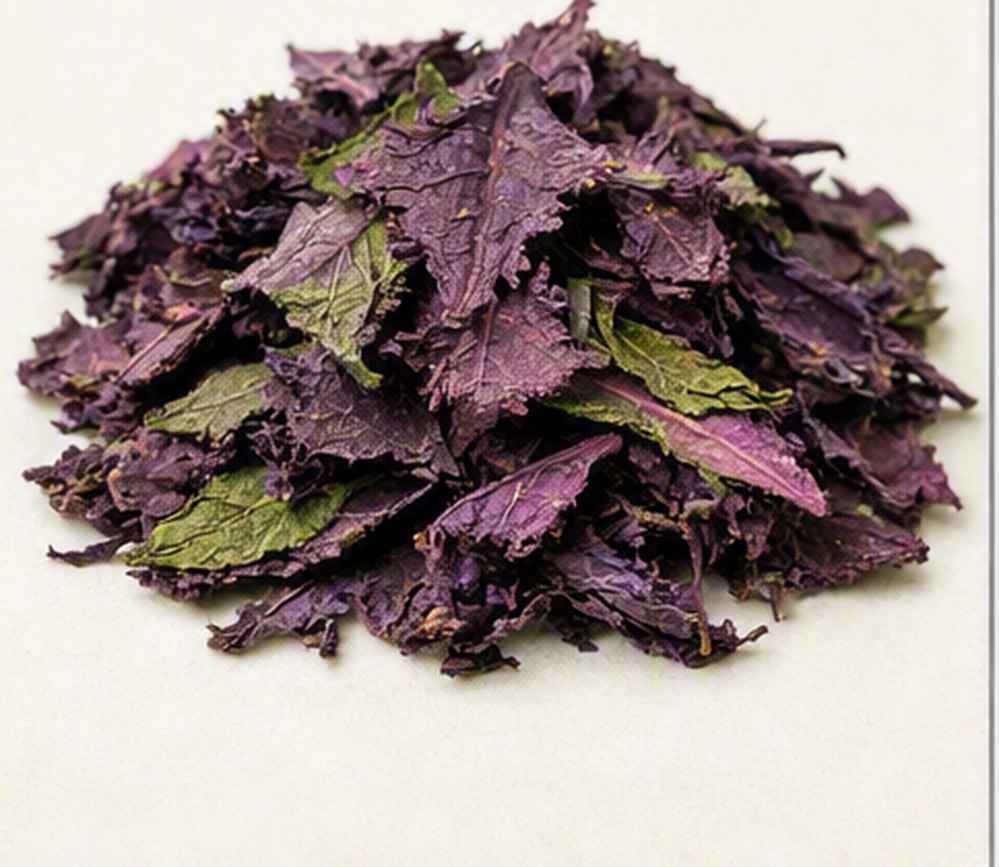
Perilla Leaf
Overview
Perilla leaf is another herb that lives equally in the kitchen and the medicine cabinet, its purple-backed leaves prized for cooking with fish and meat as much as for dispersing cold. The Donguibogam is specific that only the fragrant, purple-tinged variety counts as true medicine — the green, unscented kind is set aside as unfit for use.
In the Donguibogam
寶鑑
Traditional functions
- Disperses wind-cold at the surface
- Regulates qi, relieves fullness
- Stops nausea and food poisoning symptoms
- Warms the middle, dispels cold
Traditional applications
- Early-stage cold with chest tightness
- Bloating after seafood or rich food
- Nausea and mild food poisoning
- Cold-pattern abdominal fullness
Traditional preparation
Decoction 4–10g; a classical pairing with fish and crab dishes, and combined with tangerine peel for qi-stagnation with cold.
Cautions
Frequently asked questions
Is perilla leaf the same as the green sesame-leaf-like herb (deulkkae)?
No — the Donguibogam is explicit that only the fragrant, purple-backed variety is true medicinal perilla; the green, unscented relative (deulkkae, wild sesame) is set aside as unsuitable for medicinal use, though it is eaten as food.
Why is perilla leaf traditionally served with seafood?
Its warming, detoxifying, nausea-settling properties made it a natural pairing with fish and crab in classical practice — a food-medicine habit that continues in Korean cuisine today.
Sources
- 동의보감 탕액편 (원문) — 한문 원문 발췌 — 한의학고전DB 탕액편 대조 검증 완료 (DATA-001)
- 한의학고전DB (mediclassics.kr) — 국역 참조 후 자체 재서술 (LEGAL-001)