
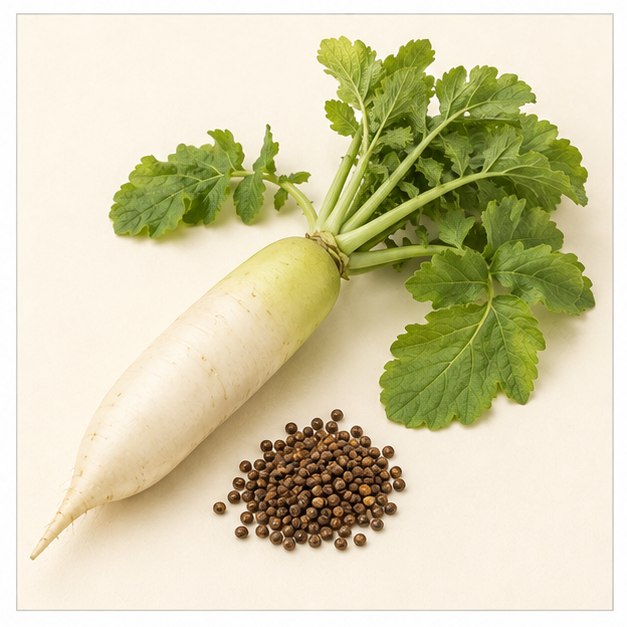
Radish
무 (萊菔) · Raphanus sativus L.
Food-stagnation-resolving herb
Warm (also recorded cool)
Pungent, sweet
Lung, Stomach
NatureWarm (also recorded cool)
TastePungent, sweet
MeridiansLung, Stomach
Part usedRoot (and seed)
FamilyBrassicaceae
CategoryFood-stagnation-resolving herb
Overview
The common radish is one of the Donguibogam’s clearest food-medicines: recorded as dissolving food stagnation and phlegm, easing thirst, and freeing the joints. Its seed (nabokja) is a distinct, more concentrated qi-moving herb still used today for bloating and cough.
In the Donguibogam
東醫
寶鑑
寶鑑
性溫, 味辛甘, 無毒. 消食, 去痰癖, 止消渴, 利關節, 練五藏惡氣. 治肺痿吐血.
Source: Donguibogam, Tangaek-pyeon (Herbology volume)
TranslationIts nature is warm, its taste pungent and sweet, and it is non-toxic. It dissolves food, removes phlegm accumulation, stops wasting-thirst, benefits the joints, refines away the foul qi of the five viscera, and treats lung wasting with blood-spitting.
Traditional functions
- Dissolves food stagnation
- Resolves phlegm
- Relieves thirst
- Frees the joints
Traditional applications
- Bloating and food stagnation
- Cough with phlegm
- Thirst
- Sluggish digestion after heavy meals
Traditional preparation
Eaten as food; the seed (Raphani Semen) is decocted 6–12g for bloating and cough.
Cautions
Caution: Traditionally said to counteract ginseng and other qi tonics, so classical sources advise against taking radish alongside tonic formulas. Its qi-moving action may not suit marked qi deficiency. Consult a professional.
Advertisement
Frequently asked questions
Why shouldn’t radish be eaten with ginseng?
Classical sources hold that radish’s qi-dispersing, downward-moving nature works against ginseng’s qi-tonifying action — so they were traditionally not combined. It is a well-known pairing caution in Korean herbal custom.
Is radish seed different from the radish itself?
Yes. The seed, nabokja (Raphani Semen), is a separate, more concentrated medicinal specifically for descending qi, easing bloating, and stopping cough with phlegm.
Sources
- 동의보감 탕액편 (원문) — 한문 원문 발췌 — 한의학고전DB 탕액편 대조 검증 완료 (DATA-001)
- 한의학고전DB (mediclassics.kr) — 국역 참조 후 자체 재서술 (LEGAL-001)
DonguiHub is an educational and informational platform about the history and tradition of Korean medicine. It does not provide medical advice, diagnosis, or treatment. Always consult a qualified healthcare professional about health conditions and before using any herb.