
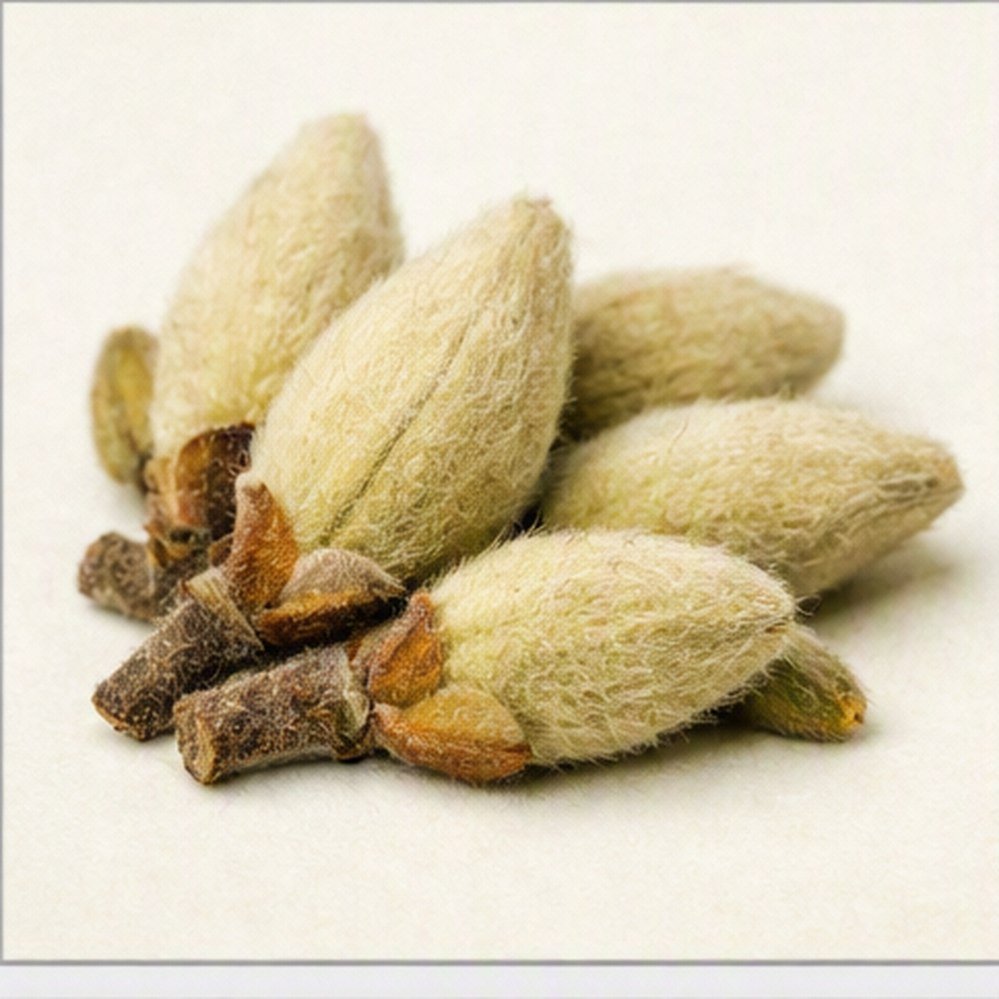
Magnolia Flower Bud
Magnolia Flower Bud (신이, 辛夷) is recorded in the Donguibogam as a orifice-opening herb. Its nature is warm and its taste pungent, associated with the Lung, Stomach meridians. Traditional uses recorded in the text include dispels wind, opens the nasal passages, relieves head and sinus pain, rises to the head to clear the orifices. Caution: Warm and dispersing; the classics note the fuzzy outer coating should be removed before use, and it is not suited to heat signs from yin deficiency.
Overview
Magnolia flower bud is gathered just before it opens, when the furry bud still resembles a small peach. The Donguibogam records it as the classic remedy for a blocked, runny nose and wind-type headache in the head — still the herb's primary role in nasal congestion formulas today.
In the Donguibogam
寶鑑
Traditional uses recorded in the Donguibogam
- Dispels wind, opens the nasal passages
- Relieves head and sinus pain
- Rises to the head to clear the orifices
Traditional applications recorded in the classical text
- Nasal congestion with discharge
- Sinus-type or wind headache
- Facial swelling with tooth pain
Traditional preparation
Wrapped in cloth when boiled per traditional preparation; the fuzzy coating is removed before use.
This describes traditional preparation recorded in the classics, not a recommendation for use today. DonguiHub does not provide dosage guidance — consult a qualified professional before using any herb.
Cautions
Frequently asked questions
What part of the magnolia is used as sini?
Only the unopened flower bud, gathered before it blooms. The Donguibogam notes its furry outer coating should be removed before the herb is used.
Is magnolia flower bud still used for sinus problems today?
Yes — it remains one of the most common herbs in modern formulas for nasal congestion and sinus-type headache, matching its classical use in the Donguibogam almost exactly.
Sources
- 『동의보감』 탕액편, 허준, 1613 (원문) — 한문 원문
- 한의학고전DB (mediclassics.kr) — 원문 및 국역 자료 참조