
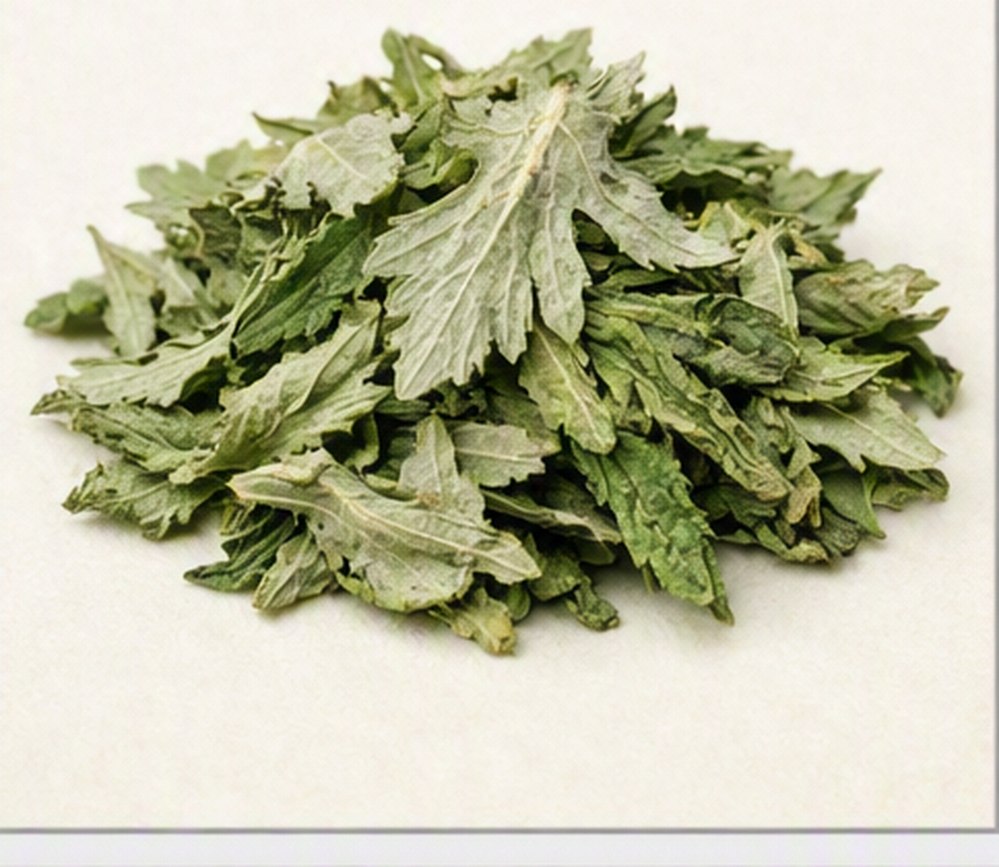
Mugwort Leaf
Overview
Mugwort leaf — ssuk, woven through Korean food, rice cakes, and the founding myth itself — is recorded in the Donguibogam as warming the womb, stopping bleeding, and calming the fetus. It is also the plant of moxibustion, dried and burned on the body, making it one of Korea’s most deeply rooted medicinal plants.
In the Donguibogam
寶鑑
Traditional functions
- Warms the channels, stops bleeding
- Warms the womb, calms the fetus
- Dispels cold, relieves pain
- Base material of moxibustion
Traditional applications
- Menstrual flooding and spotting from cold
- Cold-type menstrual and abdominal pain
- Threatened miscarriage (under professional care)
- Cold-pattern diarrhea
Traditional preparation
Decoction 3–9g; charred mugwort (Ai-tan) is used to stop bleeding, and dried mugwort floss is used for moxibustion.
Cautions
Frequently asked questions
Is the mugwort in food the same as the medicinal one?
They are closely related Artemisia species. Young spring mugwort flavors rice cakes and soups, while the mature, dried leaf (aeyeop) is the medicinal form recorded in the Donguibogam and used in moxibustion.
What is moxibustion’s connection to mugwort?
Dried mugwort floss is the material burned in moxibustion (tteum) — warming acupuncture points — making mugwort both an internal herb and the core of a major external therapy.
Sources
- 동의보감 탕액편 (원문) — 한문 원문 발췌 — 한의학고전DB 탕액편 대조 검증 완료 (DATA-001)
- 한의학고전DB (mediclassics.kr) — 국역 참조 후 자체 재서술 (LEGAL-001)