
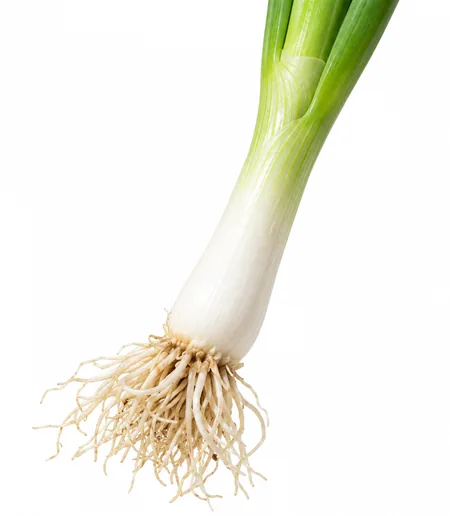
Welsh Onion (White Part)
Welsh Onion (White Part) (파(흰 뿌리), 葱白) is recorded in the Donguibogam as a exterior-releasing food herb. Its nature is cool (some sources: neutral) and its taste pungent, associated with the Not specified in the source text meridians. Traditional uses recorded in the text include releases the exterior by dispersing, benefits the five viscera, frees the bowels and bladder. Caution: The text says it should be used only to harmonize the five flavors and not eaten in quantity: it opens the joints, makes a person sweat and become weak, and dulls the spirit.
Overview
Pa, the scallion or Welsh onion, is called in the Donguibogam "the chief of the vegetables" — "though it smells, it has use" — and the entry gives it a distinctive logic: it works mainly by dispersing (releasing the exterior and sweating). The white stalk is cool and the green leaf hot, which is why formulas discard the green leaf. The text praises it as best eaten in winter, but warns it should only be used to harmonize the five flavors, because eaten in quantity it opens the joints, induces sweat that weakens a person, and dulls the spirit.
In the Donguibogam
寶鑑
Traditional uses recorded in the Donguibogam
- Releases the exterior by dispersing
- Benefits the five viscera
- Frees the bowels and bladder
Traditional applications recorded in the classical text
- Flavoring dishes (to harmonize the five flavors)
- Cold-damage with chills and fever (classical)
Traditional preparation
Planted everywhere; best eaten in winter, and only as a seasoning. For cold-damage formulas the green leaf is discarded because it is hot.
This describes traditional preparation recorded in the classics, not a recommendation for use today. DonguiHub does not provide dosage guidance — consult a qualified professional before using any herb.
Cautions
Frequently asked questions
Why does the text warn against honey and scallion together?
The Donguibogam lists scallion and honey as an incompatible pair: eating them together is said to kill, and burnt scallion mixed with honey is said to hasten a person's qi and certainly kill.
Which part is used?
The white part (cool); the green leaf is hot and is discarded in cold-damage formulas.
Why not eat it in quantity?
The text says it opens the joints, causes sweating that weakens a person, and dulls the spirit.
Sources
- 『동의보감』 탕액편, 허준, 1613 (원문) — 한문 원문
- 한의학고전DB (mediclassics.kr) — 원문 및 국역 자료 참조
Related columns
- Food Pairings the Donguibogam Says Not to Eat Together
- Scallion and Rakkyo: How the Donguibogam Saw Two Pungent Vegetables Differently